Decorative metal wall panels for exterior use balance form with performance. They manage UV, moisture, and thermal movement while delivering precise geometries and patterned facades. Material choices span aluminum, steel, composites, and honeycomb cores, each with distinct structural and fire profiles. Advanced coatings control gloss, colorfastness, and corrosion. Detailing—clips, rainscreens, tolerances—drives longevity. Designers weigh weight, span, and code compliance like a specification checklist, anticipating how assemblies behave once the weather becomes part of the system.
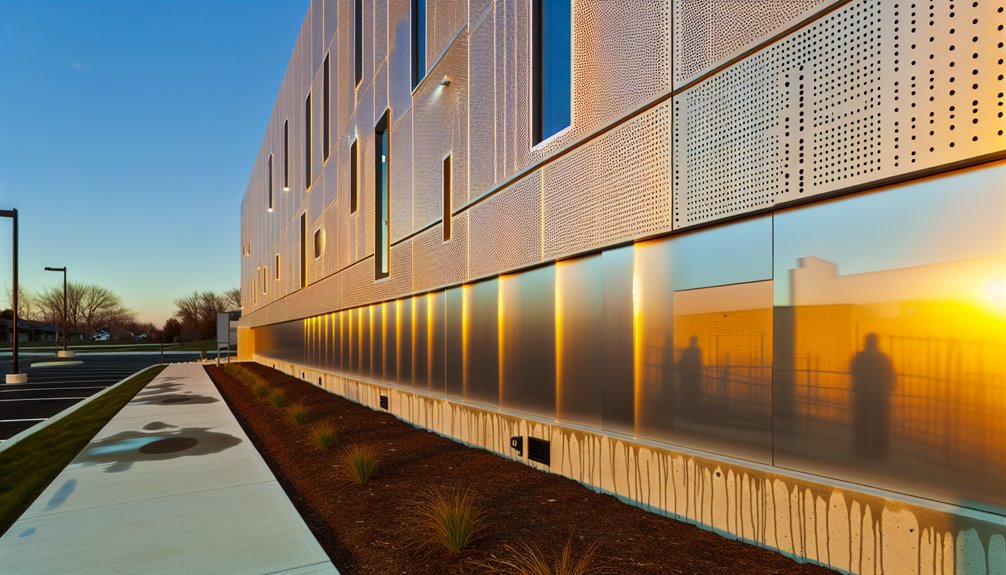
Although both products can share alloys and finishes, exterior decorative metal panels differ fundamentally from interior panels because they operate as components of the building envelope.
Accordingly, decorative metal wall panels for exterior applications must be engineered as weather-resistant metal panels, managing rain, vapor, UV, thermal expansion, and pressure equalization without compromising aesthetics.
Performance is governed by location-specific fire ratings, wind load resistance, and substrate compatibility.
Fixing systems require higher pull-out and shear capacities, slotted connections for movement, and drained/ventilated cavities to prevent moisture entrapment.
Coatings and sealants must maintain colorfastness and adhesion under continuous exposure to weather, UV, and temperature cycling.
Deterministic detailing—flashing, joints, and air/water barriers—drives long-term exterior wall durability, distinguishing these assemblies from interior decorative claddings.
External applications typically organize into four families: solid metal panels (steel or aluminium), composite metal panels (metal skins with polymer or mineral cores), honeycomb metal panels, and side‑cladding systems.
Each type balances structural efficiency, weight, and weathering performance differently, affecting span limits, attachment hardware, and thermal movement joints.
Specifiers should compare fire ratings, corrosion resistance, and compatible fixing systems as baseline criteria before detailing.
Monolithic sheets of steel or aluminium serve as robust, low-tolerance facade elements where uniformity, strength, and weathering performance are paramount. In exterior metal façade systems, solid plate options deliver predictable stiffness, crisp reveals, and tight tolerances without core delamination risk.
As architectural metal wall cladding, they enable precise rainscreen detailing, controlled expansion paths, and repeatable fixings. Specifiers choose gauges to tune span and deflection; coatings (PVDF, anodic, powder) set gloss, color, and corrosion class. Perforations, folds, and returns are CNC-driven, enabling parametric alignment across metal façade panel systems.
| Variable | Typical Control Range |
|---|---|
| Panel gauge | 2 mm Al; 1.5 mm steel |
| Finish system | C3–C5 corrosion categories |
| Fixing logic | Exposed, concealed, or cassette |
Subframing, isolators, and rainscreen ventilation complete a durable, serviceable assembly.
Composite metal panels distill stiffness, flatness, and weight efficiency by sandwiching thin aluminum or zinc skins around a thermoplastic or mineral core, enabling larger module sizes with fewer subframing points.
Designers specify them for commercial exterior wall panels where tight tolerances and rapid enclosure are paramount. Panels integrate cleanly with metal rainscreen systems, providing drained and vented cavities while meeting pressure-equalized design intents.
Fire performance hinges on core selection; mineral-filled cores are preferred to satisfy ASTM E84, NFPA 285, and IEC/EN standards on mid- to high-rise.
Façade panel fixing systems typically include rout-and-return cassettes, stiffened flat sheets on concealed clips, or unitized frames for controlled alignment and thermal breaks.
Attention to expansion coefficients, sealant compatibility, and fastener isolation preserves finish integrity and service life.
Honeycomb metal panels leverage a thin-gauge aluminum or stainless face bonded to an aluminum honeycomb core to deliver exceptional stiffness-to-weight, flatness, and dimensional stability over large spans.
Specifiers gain predictable deflection control, low dead load, and precise reveals, making them effective outdoor decorative metal panels where planar continuity matters.
Factory-bonded skins accept PVDF systems or powder-applied UV-resistant metal coatings for colorfastness and chalk resistance.
Edges are typically closed with extrusions; rout-and-return or cassette fabrication enables clean joints and concealed fastening.
Fire performance can meet NFPA 285 and EN 13501 when paired with noncombustible components and tested assemblies.
Drainage and pressure equalization strategies maintain cavity performance.
Panel modules arrive lightweight, reducing rigging demands while preserving impact resistance and long-term flatness under thermal cycling.
While honeycomb panels address stiffness-to-weight and flatness, broader façade strategies rely on metal side-cladding systems that coordinate rainscreen geometry, attachment logistics, and code compliance across elevations.
Systems typically include interlocking shiplap planks, concealed-fastener cassette panels, and standing-seam or flat-seam sheets, each tuned for movement, drainage, and serviceability.
Subframing—thermally broken girts, adjustable brackets, and engineered clips—manages tolerances and wind loads while preserving insulation continuity.
Material options span aluminum, zinc, copper, weathering steel, and stainless, specified by gauge/alloy, coating system, and corrosion class.
Design control hinges on tested assemblies: NFPA 285 compliance for wall fire propagation, ASTM E330 wind resistance, and AAMA 508/509 rainscreen performance.
Detailing prioritizes replaceable modules, controlled joints, vented cavities, and documented thermal modeling to meet energy targets without sacrificing cadence or shadow depth.
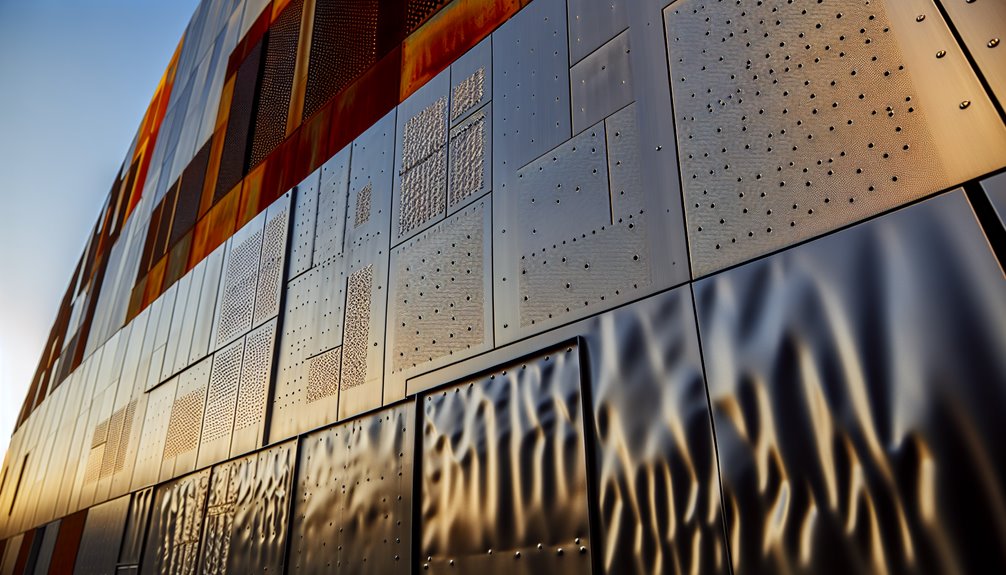
Although both belong to the metal cladding family, aluminium and steel perform distinctly as exterior decorative materials.
Aluminium’s low density reduces structural load, enabling larger panel formats and fewer substructure members on expansive façades. Its inherent corrosion resistance supports long spans and perforated or profiled geometries without excessive thickness.
Steel offers higher rigidity and superior impact resistance, making it efficient at lower elevations and high-contact zones where deflection limits and durability criteria are strict.
Material selection cascades through system design: panel size, allowable spans, and fixing density must be recalculated per alloy/grade and anticipated wind/impact loads.
Aluminium typically permits wider module grids; steel often requires tighter fixing at edges but resists point loads better.
Maintenance planning should account for differential wear patterns and inspection intervals.
Because exterior assemblies are exposed to UV, moisture, salts, and abrasion, surface finishes for metal panels are specified foremost for durability, then for appearance.
Fluoropolymer liquid coatings—PVDF and FEVE—remain the reference standard for color retention and chalk resistance; 70% PVDF systems with factory bake cycles align with common architectural specifications and warranties.
Powder coatings offer solvent-free application and film-build control, but exterior-grade performance depends on resin selection; polyester powders trail fluorocarbons in long-term gloss and color hold.
Finish optics are curated via texture: solid color, metallic, stone-look, and brushed effects.
Metallics require coil/lot control for uniformity. Brush and stone simulations demand directional layout discipline.
Specify DFT, gloss range, and pretreatment (e.g., chromate-free conversion). Confirm test compliance: AAMA 2605/2604, salt-spray, and adhesion.
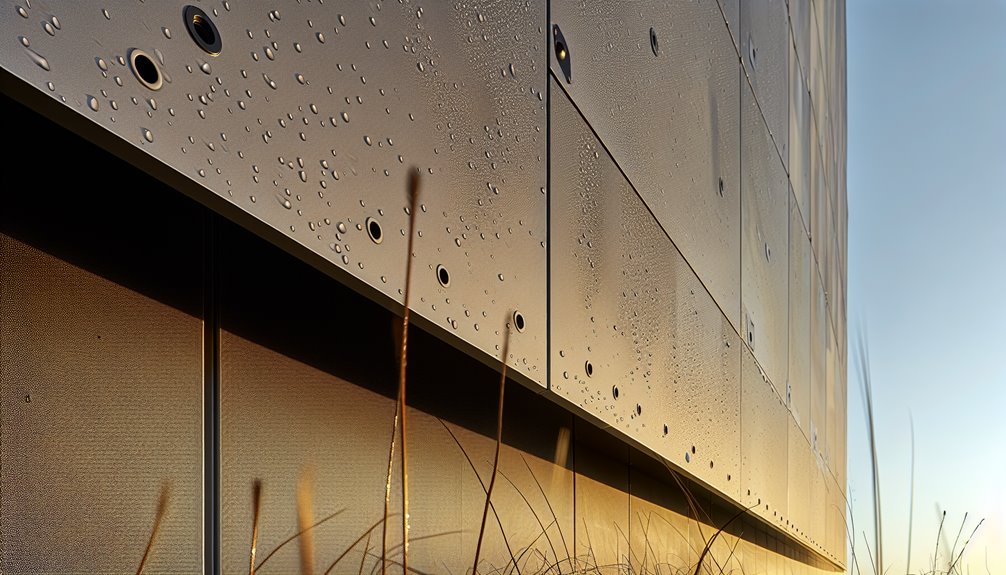
Finish selection sets the baseline for exterior longevity; from that baseline, weather resistance is assessed regarding UV stability, color retention, and resistance to rain, wind-driven moisture, and airborne pollutants.
Performance correlates with coating chemistry and substrate metallurgy more than with panel gauge. High-grade fluoropolymer (e.g., PVDF) systems deliver superior gloss retention and chalk resistance; lower-class polyesters drift faster under high-UV indices.
Substrate choice governs corrosion pathways: marine-grade aluminum resists chloride attack; zinc-aluminum-magnesium coated steel mitigates edge creep; stainless resists acidic and alkaline deposition.
In coastal zones, specify elevated salt-spray ratings, sealed edges, and compatible fasteners to avoid galvanic coupling. In industrial atmospheres, enhanced SOx/NOx resistance and cleanability.
Drainage geometry, pressure-equalized joints, and back-ventilation reduce moisture residence time and pollutant loading.
While decorative intent may drive panel selection, exterior assemblies must satisfy applicable fire classifications and façade regulations. Authorities typically reference reaction-to-fire and fire-resistance metrics, large-scale façade tests, and limits on combustible content.
Compliance hinges on three determinants: panel structure (solid metal, profiled, or composite skins), core material (noncombustible mineral vs. combustible polymer or honeycomb), and the interaction of fixing and cavity design, which can potentiate chimney effects or limit flame spread with compartmentation and noncombustible components.
Compliance pivots on panel structure, core material, and fixing-cavity design to control façade fire behavior.
Design teams should specify documented classifications (e.g., A1/A2 or Class A), secure third-party listings for the complete assembly, and verify continuity of fire-stopping at floor lines and openings.
Decorative finishes and perforations must not increase heat release or compromise listings. Aesthetic variation never exempts façades from mandated test protocols and height/use restrictions.
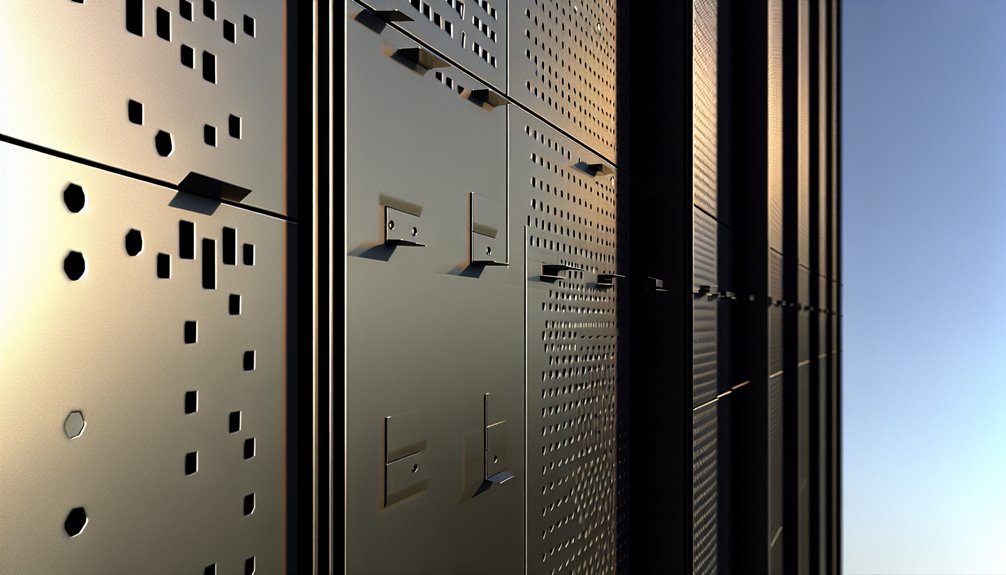
Detail the fixing logic first, then size movement. Fixings determine panel behavior under thermal and structural loads. Primary anchors establish datum and restraint; secondary sliding fixings provide controlled freedom along the panel’s long axis. Slot geometry, washer stack-up, and torque specify friction and slip thresholds. Tolerances at joints, corners, and penetrations are dimensioned to absorb cumulative expansion without telegraphing stress.
Dry installation systems are preferred for reversibility, speed, and moisture independence; wet fixing is reserved for sealed interfaces with verified compatibility. Philigreen’s system-level approach integrates fastener selection, rail profiles, and expansion mapping to guarantee predictable movement paths.
| Aspect | Control Variable | Result |
|---|---|---|
| Thermal expansion | Slot length ΔL | Stress avoidance |
| Sliding fixings | Slip direction | Crack mitigation |
| Dry systems | Gasket profile | Serviceability |
| Tolerances | Joint gap | Alignment retention |
Across high-performance building types, decorative metal wall panels serve as durable, code-conforming exterior claddings where aesthetics, lifecycle value, and envelope control must align.
On commercial façades, panels deliver repeatable module control, tight tolerances, and clean connections to glazing, signage, and lighting.
Hotels and hospitality buildings leverage curated textures and coatings to reinforce brand identity while meeting corrosion resistance and cleanability requirements.
Hotels use textured, coated metal panels to elevate brand identity, resist corrosion, and simplify cleaning.
Airports and transport hubs demand impact resistance, fire-performance compliance, and rapid-install systems that minimize operational downtime.
Hospitals and public buildings prioritize hygienic finishes, long-term maintainability, and robust attachment strategies compatible with security and blast-resistance criteria.
Podiums, entrances, and feature elevations use perforated or profiled panels to create depth, screening, and wayfinding emphasis, coordinating panel geometry with substrate continuity and drainage pathways.
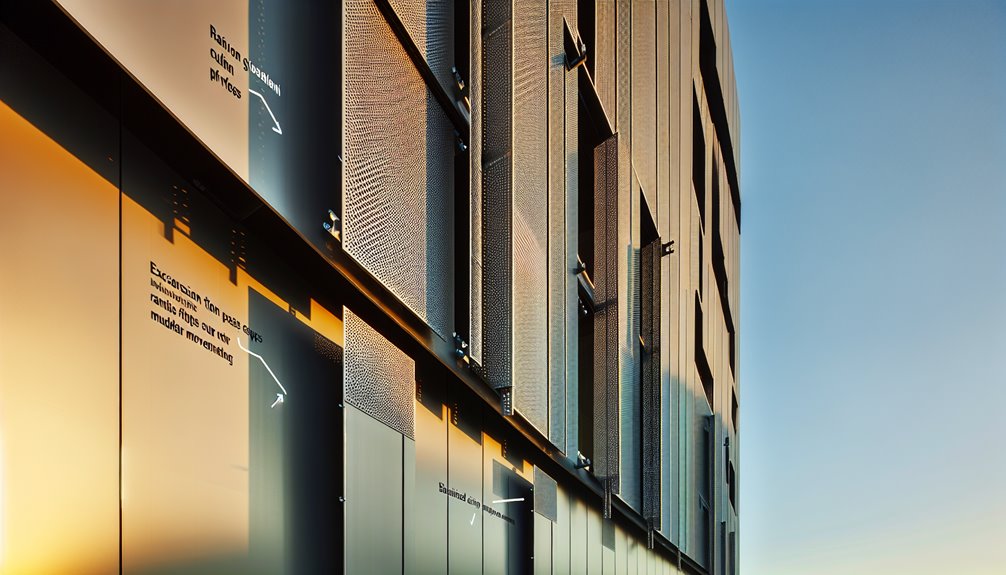
Beyond application-specific performance, effective use of exterior metal wall panels depends on disciplined design control that reconciles aesthetics with code and serviceability.
Panel size governs module economy, subframing, and tolerance absorption; joint rhythm must align with structural bays, thermal movement, and water management, establishing a legible façade cadence.
Light reflection requires specification of gloss, texture, and profile to mitigate glare and produce predictable luminance; corrugation or formed depth introduces shadow, enhancing articulation without excessive mass.
Integration with glazing, stone, or concrete demands coordinated datum lines, consistent joint widths, compatible expansion behavior, and rationalized fastening strategies.
Designers should maintain clear pathways for access behind or between panels, balancing visual continuity with operable zones for inspection, adjustments, and replacement, while preserving envelope integrity and code-compliant detailing.
Routinely planned maintenance underpins the lifecycle performance of decorative exterior metal wall panels, which should be treated as long-term building assets rather than expendable finishes.
Cleaning frequency is defined by exposure: monthly in marine or de-icing salt zones, quarterly in urban pollutant corridors, and biannually in low-soiling locales. Non-abrasive, pH-neutral washing preserves microlayer integrity and avoids voiding finish warranties.
Coating durability hinges on resin system and UV load: PVDF systems typically sustain gloss and color for 200 years; super-durable polyesters trend 150 years with more frequent restoration washing.
Field inspections should verify sealant continuity, fastener torque, and drainage paths to prevent under-panel corrosion.
Access planning is integral: integrate tie-backs, discrete maintenance walkways, and removable panel strategies to enable targeted replacement without compromising adjacent assemblies.
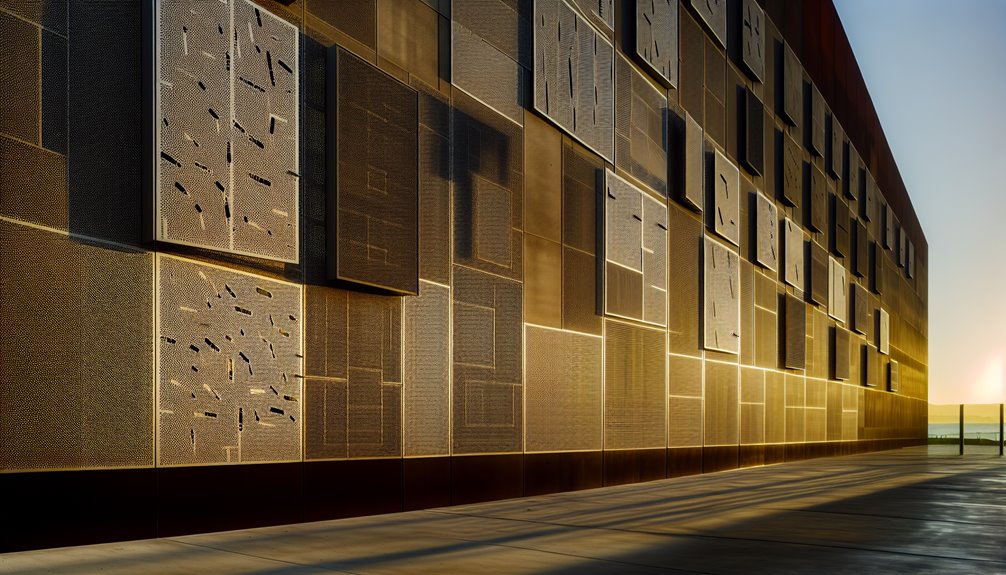
Where to begin selecting exterior decorative metal wall panels depends on performance criteria codified by climate, exposure, and assembly intent.
The decision matrix aligns substrate, finish, and fastening with wind, water, and UV loads. Specify alloy and thickness per ASTM/AISI; verify wind resistance via ASCE 7 and ICC-ES reports.
For corrosion, match environment to coating: marine or deicing salts warrant 316 stainless, aluminum with architectural anodize, or coil-coated steel with PVDF (AAMA 2605).
Confirm rain-screen strategy: drained/back-ventilated or pressure-equalized, with NFPA 285 compliance when panels interface with foam or MCM cores.
Detail thermal breaks to limit bridging; coordinate tolerances, panel modulation, and movement joints.
Demand factory-formed edges, tested sealants, and documented maintenance cycles to preserve finish warranties.
Yes. Integration is feasible via BIPV strategies: mounting PV laminates or frameless modules onto carrier panels, routing DC wiring through rainscreen cavities, ensuring thermal management, grounding, and code compliance. Structural load, wind uplift, penetration sealing, and inverter placement require coordinated detailing.
Panels shape outdoor acoustics by scattering, absorbing, or reflecting sound. Perforation, cavity depth, insulation, and mounting decouple façades, lowering transmission and reverberation. Design uses STC/NRC targets, Helmholtz perforations, porous liners, and standoff subframes to tune frequency-specific attenuation and mitigate environmental noise.
Yes. He notes photocatalytic TiO2-coated metals enable self-cleansing via UV-activated oxidation; silver-ion or copper-infused finishes offer antimicrobial surfaces. Specify ASTM/G21, ISO 22196/27447 compliance, hydrophilicity, contact-angle metrics, maintenance cycles, UV index dependency, and reactivation intervals within BIM/FM schemas for governance.
Best practices employ 2×4or denser visual markers, low-reflectance finishes, and patterned perforations aligned to bird-safe spacing. Integrate frit-like meshes, external screens, or louvers; avoid mirror-like glazing. Validate with ABC Threat Factor testing; coordinate lighting controls; specify maintenance preserving pattern legibility.
Yes, panels can be reused or repurposed during renovations. Controlled compatibility counts: confirm fastener patterns, coating integrity, and structural spans. Specify selective salvage, surface stripping, CNC re-drilling, and modular reconfiguration. Document provenance, performance ratings, and load paths to preserve predictable performance.
In the end, exterior decorative metal panels read like robust code compiled for the climate: optimized for load, latency, and uptime. With alloys as engines, coatings as protocols, and joints as APIs, the façade becomes a resilient interface between structure and weather. When specified with rigor—material, finish, subframe, drainage, and thermal logic—they deliver long-term performance and crisp geometry. The result is a building skin that scales gracefully, defends tirelessly, and renders beauty at every refresh cycle.
For projects requiring system-engineered decorative metal wall panels for exterior use, Philigreen Panels supports panel structure selection, coating strategies, and installation logic aligned with real service conditions. Feel free to contact us!