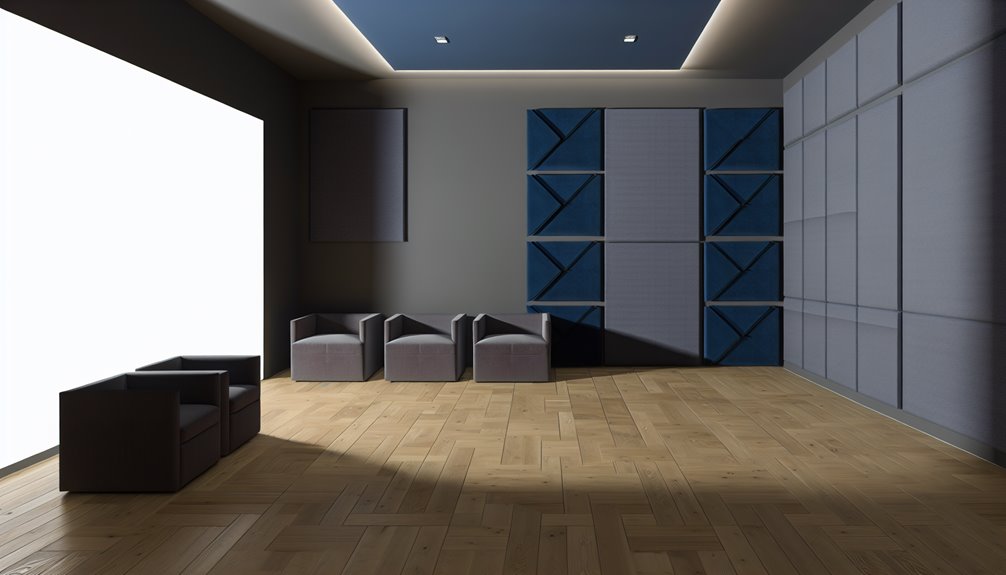
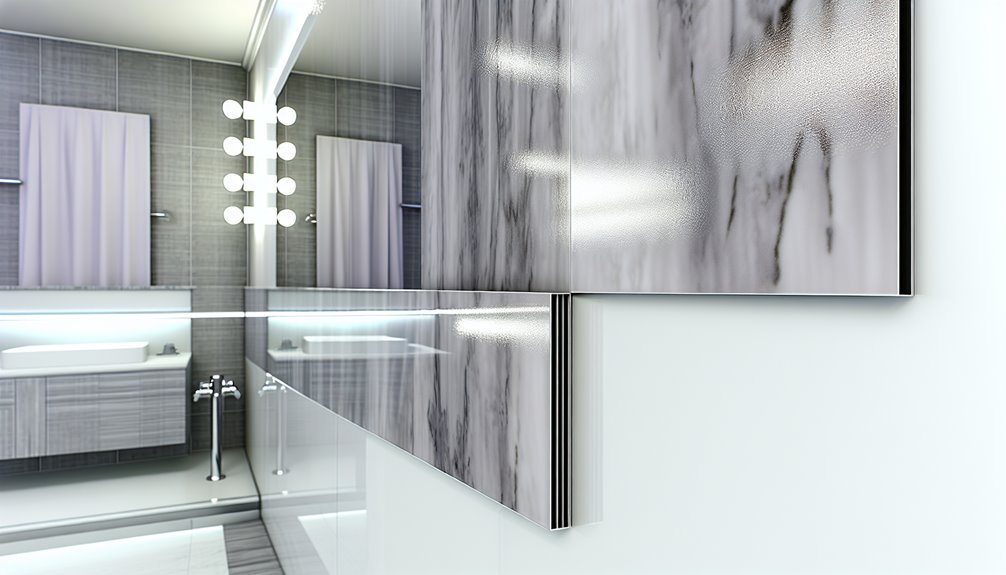
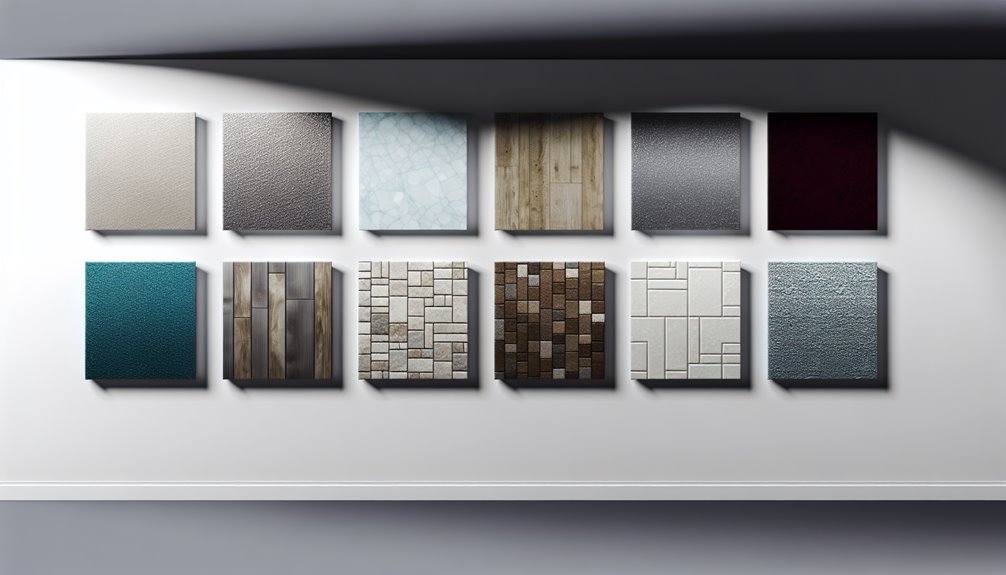
Honeycomb metal panels offer high stiffness-to-weight performance, predictable load paths, and durable finishes for commercial envelopes and interiors. Their hexagonal cores reduce dead load, support larger spans, and can meet fire, wind, and seismic criteria when detailed correctly. Aluminum and stainless options address corrosion zones and recyclability targets. Yet thermal bridging, fastening, and movement control can undermine outcomes if overlooked. Understanding material choices, testing standards, and installation tolerances becomes decisive before committing to a specification.
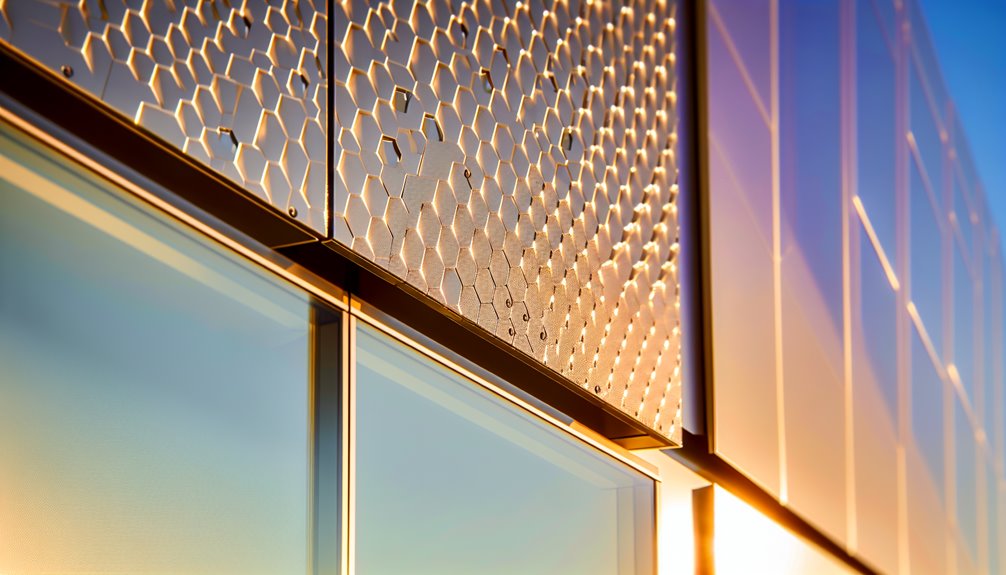
A honeycomb metal panel is a high-performance sandwich construction comprising a hexagonal-cell core bonded between two thin metal face sheets to deliver exceptional stiffness-to-weight. The core’s hollow cells distribute loads uniformly, increasing specific strength while minimizing mass.
High-performance sandwich panel: hexagonal-cell core between thin metal faces delivers exceptional stiffness-to-weight and uniformly distributed loads.
Configurations include flat or curved geometries to meet envelope and interior tolerances. Aluminum honeycomb panels are common for corrosion resistance, fire performance, and moisture control; stainless options address extreme environments.
Nomex, Kevlar, and thermoplastic cores are available where dielectric, fatigue, or recyclability parameters govern. A metal honeycomb core panel provides predictable bending and shear behavior, enabling precise deflection limits and wind-load compliance.
Designers should consider impact sensitivity, salt-spray exposure, and face-to-core bond integrity when specifying a honeycomb metal panel for commercial building systems.
Building on the panel’s sandwich construction and predictable stiffness-to-weight behavior, honeycomb assemblies are selected for architectural wall systems to meet performance, code, and lifecycle targets.
A honeycomb panel wall system uses high strength to weight ratio panels to achieve wind-load resistance without imposing dead-load penalties, enabling smaller supports and faster installation.
Lightweight metal wall panels limit transport and rigging costs while maintaining flatness and dimensional stability; panels do not sag or buckle under service loads.
Non-combustible skins and cores support fire-resistance objectives and reduce reliance on additional treatments.
Durable finishes resist corrosion and discoloration, lowering maintenance frequency.
Broad finish and form options allow consistent façades and coordinated ceilings.
Recyclable aluminum content and reduced shipping energy support sustainability objectives.
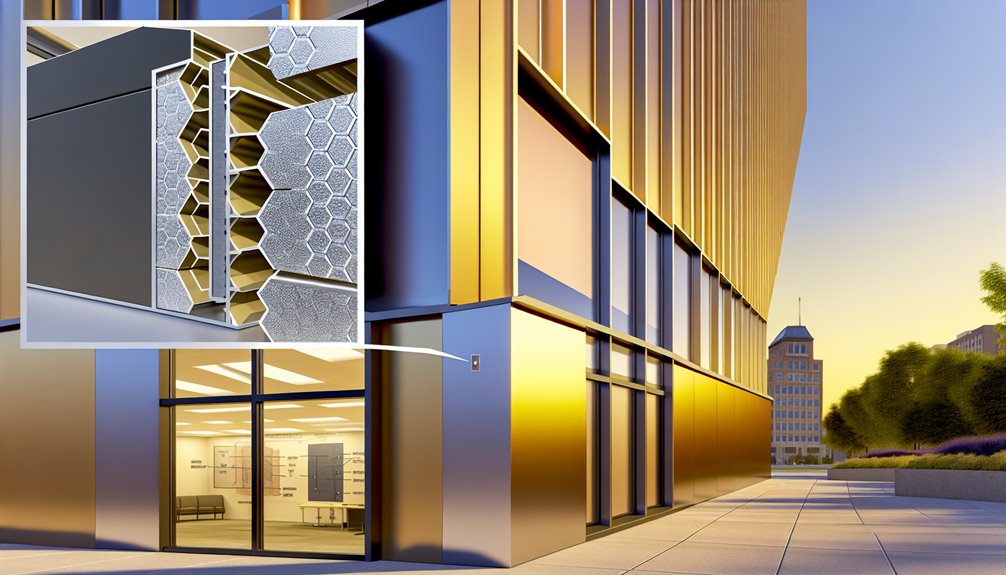
Honeycomb panels are most appropriate when a project demands a high stiffness-to-weight ratio, long-span flatness, and non-combustible performance under demanding wind, fire, or seismic conditions. In these scenarios, the structural efficiency of the honeycomb core allows large-format panels to remain flat and stable while reducing overall system weight and sub-framing requirements.
In contrast, where spans are short, design loads are modest, or fire and deflection criteria are less stringent, simpler composite panels or single-skin metal systems can often achieve the required performance with lower cost and reduced system complexity. Over-specifying honeycomb panels in such conditions may increase budget and coordination effort without delivering meaningful functional benefits.
In architectural applications, honeycomb panels are typically prioritised for deep soffits, large-format façade or rainscreen modules, and areas with strict deflection, impact, or blast-resistance requirements. While architectural honeycomb panels provide highly predictable flatness and allow for lighter support structures, their performance depends heavily on accurate detailing and controlled installation tolerances. Poor coordination at joints, fixings, or sub-frames can negate their inherent advantages.
| Design Driver | Honeycomb Panels | Simpler Panel Systems |
|---|---|---|
| Span & load | Long spans, high wind or pressure loads | Short spans, low structural demand |
| Fire & code | Non-combustible, stringent compliance | Limited or exempt requirements |
| Flatness control | Excellent, large-format stability | Adequate for smaller panels |
| Cost & complexity | Higher, justified by performance | Lower, sufficient for many uses |
Selecting between aluminum honeycomb panels and steel honeycomb panels hinges on strength-to-weight ratio, corrosion resistance, fire performance, and life-cycle cost under relevant building codes.
Aluminum systems prioritize low mass, high stiffness, and corrosion resistance for exterior cladding and roofs, while steel offers higher modulus and impact tolerance for high-load, blast, or extreme-temperature zones.
Specifications should reference tested assemblies (e.g., NFPA 285, ASTM E330/E283/E331, ASTM E84) and project-specific wind, seismic, and thermal criteria.
Aluminum honeycomb panels deliver superior strength-to-weight performance and corrosion resistance, making them the preferred choice over steel honeycomb panels for most interior fit-outs and façade systems.
Specifiers gain mass reduction without sacrificing stiffness, enabling larger spans, reduced subframing, and precise alignment of large format wall panels. Systems meet typical wind, impact, fire, and acoustic criteria when paired with certified skins and coatings such as PVDF or anodized aluminum.
Compared with steel honeycomb panels, aluminum options simplify handling, reduce anchorage loads, and mitigate galvanic risk with compatible fasteners.
Panels maintain flatness over long dimensions, support tight tolerance interfaces, and integrate with rainscreen, unitized curtain wall, and cleanroom assemblies.
For controlled environments, aluminum cores with non-outgassing faces and thermal adhesive films enhance durability, peel strength, and lifecycle performance.
Steel honeycomb panels are specified where impact resistance and abuse tolerance govern design decisions. Their higher dent resistance and point-load capacity make them suitable for high-traffic or damage-prone environments, including loading areas, transit facilities, schools, and healthcare corridors.
While heavier than aluminum systems, steel honeycomb panels—using galvanised or stainless steel skins with steel cores—offer improved resistance to repeated impact and surface damage, reducing repair frequency in demanding applications. Designers must balance this durability against increased weight by carefully coordinating subframe capacity, anchorage spacing, and structural load paths.
| Consideration | Steel Honeycomb Performance |
|---|---|
| Impact & dent resistance | Superior in high-abuse areas |
| Traffic exposure | Well-suited to frequent contact |
| Fire & smoke performance | Non-combustible skins; robust ratings |
| Life-cycle cost | Fewer repairs in demanding use |
Proper specification should address corrosion protection (appropriate stainless grades or hot-dip galvanising), drainage and moisture management, sealant compatibility, and compliance with IBC and NFPA fire requirements.
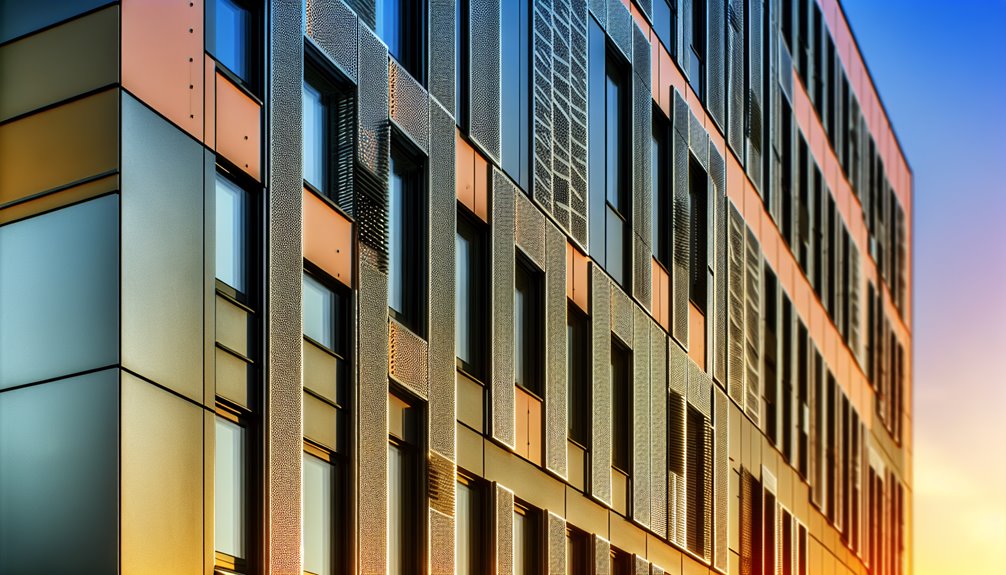
While honeycomb panels promise high specific strength and low weight, several performance gaps often emerge in design documents.
Impact behavior is frequently idealized; thin face sheets can suffer denting and irreversible core crush from point loads, compromising serviceability long before ultimate capacity.
Stiffness is often overestimated: increasing panel thickness boosts bending rigidity only if face-sheet gage, core density, cell size, and bonding are coordinated—otherwise field deflection under wind and stack effect exceeds criteria in IBC/ASCE 7.
Fire safety assumptions also drift. Not all cores and adhesives achieve the same flame spread, smoke, or NFPA 285/BS 8414 assembly performance; verification must be assembly-specific.
Acoustic and vibration control is nontrivial: lightweight panels transmit and re‑radiate noise.
Detailing requires decoupling, damping interlayers, and verified laboratory STC/OITC data.
Finish selection governs service life and appearance of honeycomb metal panels, with factory-applied systems providing controlled film build, cure, and adhesion that field applications rarely match.
Specifiers typically choose PVDF, FEVE, high-performance powder, or anodize to balance corrosion resistance, UV stability, and gloss retention. Factory application guarantees color batch control, uniform DFT, and validated cure, improving warranty reliability and predictive maintenance cycles.
Durability versus visual consistency must be explicitly prioritized. PVDF excels in colorfastness and chalk resistance; anodize offers metallic clarity but demands alloy and lot discipline.
Abrasion, cleaning chemistry, and soil load dictate topcoat hardness and texture. Low-VOC, non-abrasive cleaners are recommended to preserve films and maintain gloss.
Establish cleaning frequency by exposure category, document approved detergents and mitts, and verify erodibility limits through manufacturer test data.
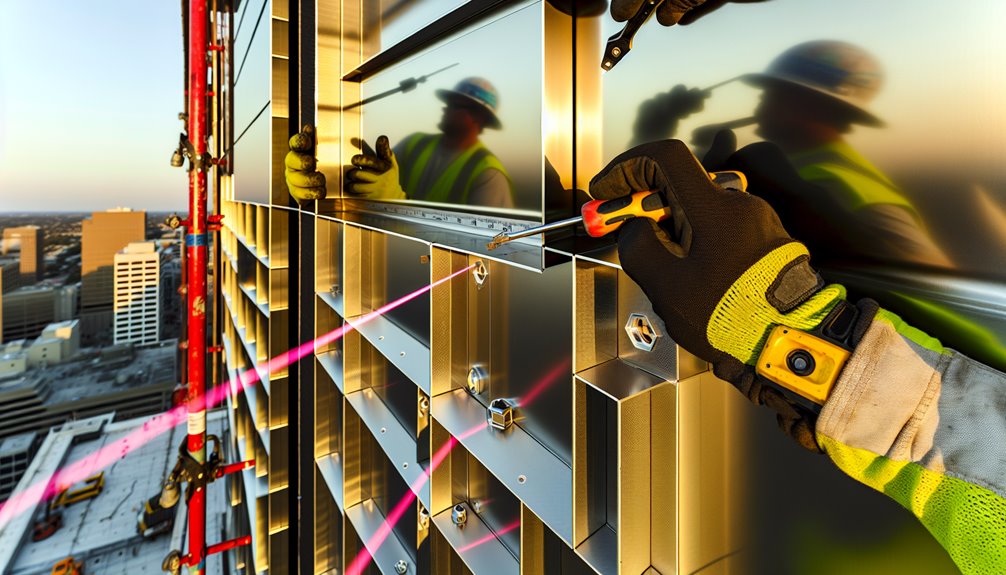
Proper installation of honeycomb metal panels begins with a code-compliant substructure and fixing logic that accounts for panel modularity, wind loads, and substrate compatibility.
Detailing must coordinate joint geometry, sealant or gasket selection, and drainage paths to achieve air-water barrier continuity and NFPA/IBC requirements.
Movement and tolerances are managed with engineered clips, slotted fasteners, and expansion joints sized for thermal gradients, fabrication variance, and building drift.
Because panel flatness is a function of the support system as much as the panel itself, the substructure must be engineered to control deflection, accommodate movement, and deliver continuous, code-compliant load paths.
Rational fixing logic begins with a verifiable substrate: plumb primary structure, calibrated rails or girts, and bracket spacing set by calculated wind, seismic, and impact loads. Members are sized for serviceability limits to prevent read-through, oil-canning, or telegraphing.
Compatible metals and isolators mitigate bimetallic corrosion. Adjustable brackets provide plane control; shims are minimized and documented.
Fastener selection is governed by pull-out, shear, and fatigue requirements, with tested anchors into each base material. Fixings are detailed for drainage and pressure moderation, and all components maintain the tested rainscreen assembly classification.
With the substructure engineered for stiffness and load paths, panel performance depends on joints that manage movement, shed water, and preserve flatness over service life.
Joint strategy is decisive: thermal expansion of metal skins and cores drives differential movement; poor detailing telegraphs oil-canning, open gaps, and water ingress.
Engineered joints must accommodate calculated movement ranges without over-constraining panels, while maintaining rainscreen continuity, drainage, and pressure moderation.
Tolerances are set to harmonize fabrication, field survey, and installation, ensuring repeatable alignment and code-compliant performance under wind, seismic, and thermal loads.
Across commercial buildings, honeycomb metal panels are specified for high-traffic, code-driven environments where strength-to-weight, fire performance, and durability are critical.
Typical applications include hotel lobbies and corridors, where thin-gauge facesheets over aluminum or stainless cores deliver flatness, impact resistance, and Class A/A2 fire performance while controlling dead load on substrates.
Elevator halls and circulation areas use abrasion-resistant skins, concealed fasteners, and tamper-resistant edges to meet ADA clearances and IBC/IFC flame spread and smoke development limits.
Airports, stations, and public facilities deploy panels as interior wall cladding, soffits, plenum lids, and column covers to satisfy NFPA 285-adjacent assemblies, seismic anchorage, and stringent cleaning cycles.
Perforated options support acoustic targets; PVDF or anodized finishes resist contaminants.
Factory-fabricated modules accelerate night-shift installations and reduce shutdown durations.
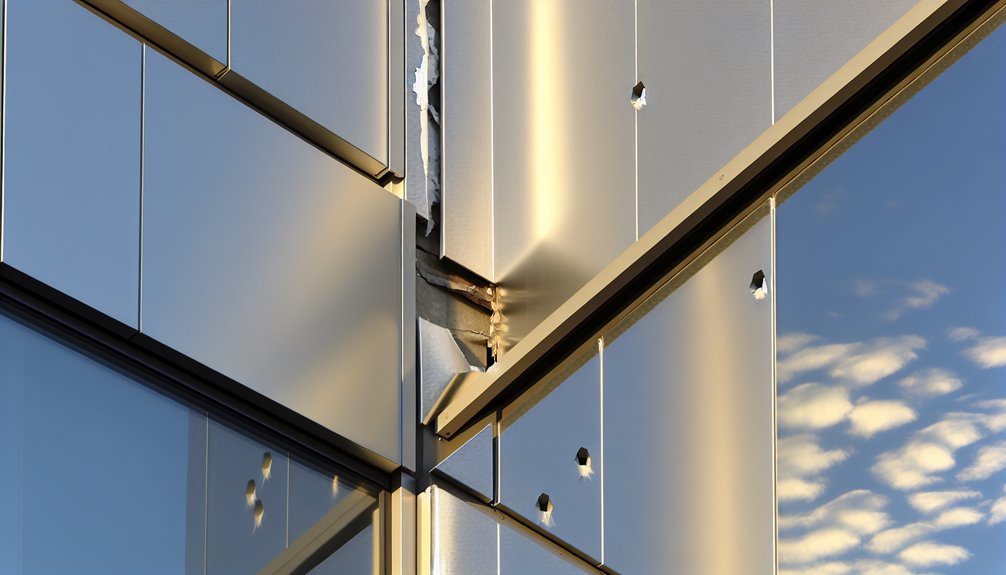
Three recurring specification errors undermine performance: overestimating honeycomb panel impact resistance, neglecting repair/replace logistics, and equating low mass with durability.
Specifiers sometimes assume high specific strength translates to dent resistance; it does not. Impact criteria must reference instrumented tests (e.g., soft- and hard-body impact per relevant façade standards) and define acceptance limits for permanent set.
Maintenance strategies require documented access, panel modularity, and stocked spares to control downtime.
Lightweight assemblies can still be vulnerable to point loads and edge crush without proper face sheet thickness, core density, and perimeter reinforcement.
Philigreen provides architectural honeycomb metal panel solutions developed for commercial and public buildings where flatness, durability, and long-term performance are critical. Our systems focus on coordinated panel design, controlled detailing, and practical installation, helping project teams achieve consistent results across large wall areas.
Panels are manufactured using code-compliant, non-combustible materials and formaldehyde-free assemblies, supporting fire safety, moisture resistance, and indoor air quality requirements. Both flat and curved configurations are available, allowing designers to maintain visual alignment while reducing unnecessary subframing.
Rather than treating honeycomb panels as stand-alone products, Philigreen approaches them as part of an integrated wall system. Panel construction, fixing logic, and joint detailing are developed together to minimise on-site variability and improve finish quality.
Material selection and surface finishes are chosen with life-cycle durability and maintenance in mind, making the systems suitable for interior and exterior applications in hospitality, healthcare, transportation, and office projects.
They can achieve required fire ratings when cores and skins are noncombustible, and assemblies are tested per ASTM E119/UL 263. Performance hinges on core type, adhesive, joint detailing, firestops, and continuity with rated framing, penetrations, and perimeter interfaces.
Recommended schedule: quarterly visual inspections, biannual wash with pH‑neutral detergent, annual sealant/joint audit, five‑year fastener torque check, and after-event (wind/seismic) inspections. Like pit-stop telemetry, one project cut defects 38% by tightening intervals, preserving warranties, and NFPA/IBC compliance.
Yes. Manufacturers commonly publish product-specific EPDs and, where relevant, HPDs. Specifiers should request third-party verified, ISO 14025-compliant EPDs and HPD v2.3 documents, ensuring declared units, PCR alignment, system boundaries, and VOC/ingredient disclosures meet project certification requirements.
They integrate through reinforced fixing zones and subframes coordinated with façade access systems such as BMUs, davits, or monorails. Loads are transferred to the primary structure rather than the panel skins, with early coordination ensuring safety compliance and finish integrity.
Contractors should typically allow 10–12 weeks after shop drawing approval, covering fabrication, finishing, assembly, and logistics. Projects requiring testing, mock-ups, or extended QA/QC reviews may need additional time, so early coordination is recommended.
Honeycomb metal panels provide reliable, code-compliant performance where stiffness-to-weight efficiency, fire resistance, and corrosion control are essential. Testing shows that hexagonal core geometry enhances flexural rigidity and buckling resistance, not just weight reduction.
Achieving long-term performance depends on correct material selection, fastening strategy, detailing, and NFPA/IBC compliance, particularly where impact, point loads, or thermal effects are present. Philigreen’s engineered honeycomb panel systems address these conditions with specification-ready solutions for commercial and public buildings.
If you are evaluating honeycomb metal panels for a project, Philigreen can support system selection and detailing review based on your design and performance requirements. Contact us now!