Fiber cement siding is water-resistant, not waterproof. It effectively manages moisture in wet climates, preventing rot and warping. Comprising cement, sand, cellulose fibers, and additives, it excels at moisture control. Proper installation, including sealing edges and using weather barriers, is critical for peak performance. Addressing common moisture issues like improper flashing and drainage is essential. For an in-depth understanding of maximizing its water resistance and comparing it to other materials, further exploration is recommended.
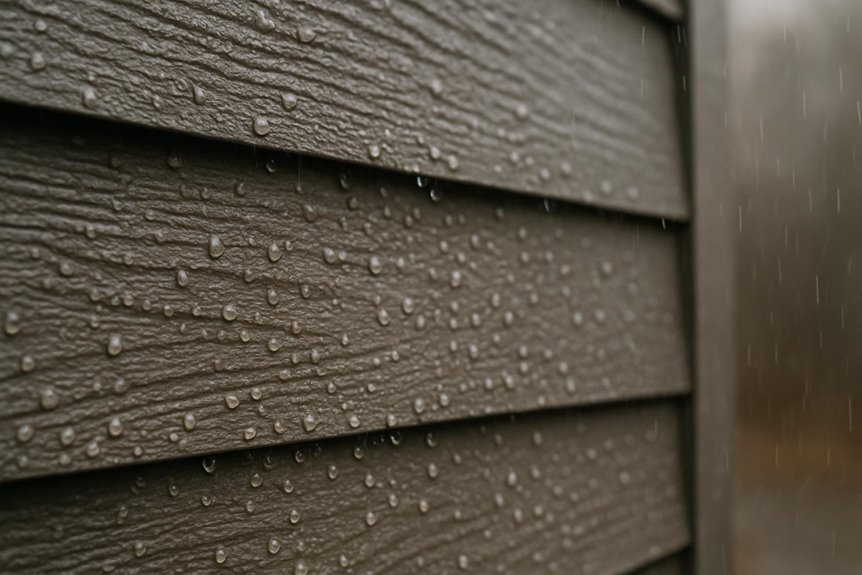
Fiber cement siding, while highly effective in resisting moisture, is not entirely waterproof. It provides substantial moisture resistance, offering a robust barrier against rain and humidity.
Designed for wet climates, fiber cement siding excels in rain resistance, preventing common issues like rot and warping that affect wood. However, it is essential to understand that fiber cement cladding is not a waterproof barrier.
It can absorb minimal moisture at seams and unsealed joints, necessitating a well-planned wall assembly for thorough protection. This involves using a weather-resistant barrier underneath to enhance its functionality.
Proper installation and maintenance guarantee that the moisture resistance of fiber cement siding is maximized, making it a preferred choice in environments prone to frequent wet weather.
With a composition of cement, sand, cellulose fibers, and mineral additives, fiber cement siding exhibits significant moisture handling capabilities. This engineered material stands out in environments prone to moisture, providing reliable fiber cement wall moisture protection.
While not entirely a waterproof fiber cement board, it effectively resists rot and mold, minimizing fiber cement siding water damage.
These characteristics collectively answer concerns like "does fiber cement absorb water?" with confidence.
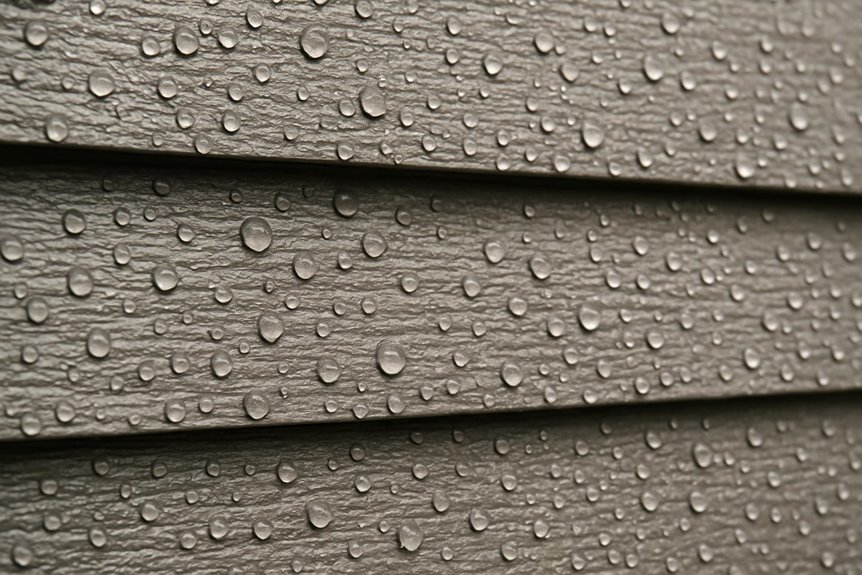
While fiber cement siding demonstrates impressive moisture management capabilities, it is not entirely impermeable. This material can absorb small amounts of moisture, particularly at cut edges, unsealed penetrations, and exposed joints. Proper detailing during installation is essential to minimize these absorption risks. The inclusion of a weather-resistant barrier and diligent sealing of cut edges can mitigate potential water absorption, preserving the siding’s durability and performance.
| Area of Concern | Mitigation Strategy |
|---|---|
| Cut Edges | Seal thoroughly |
| Unsealed Penetrations | Use proper caulking |
| Exposed Joints | Guarantee tight fitting |
| Installation | Follow detailed guidelines |
Understanding these characteristics allows homeowners to maintain fiber cement siding’s structural integrity and aesthetic appeal over time.
In the domain of exterior cladding, the emphasis on water resistance over waterproofing is essential for effective building envelope performance. Modern wall systems prioritize moisture management through water shedding, drainage, ventilation, and drying capability rather than complete moisture elimination. This approach guarantees that buildings remain resilient and durable, accommodating natural weather variations without significant damage.
This nuanced strategy enhances overall structural integrity and sustainability.
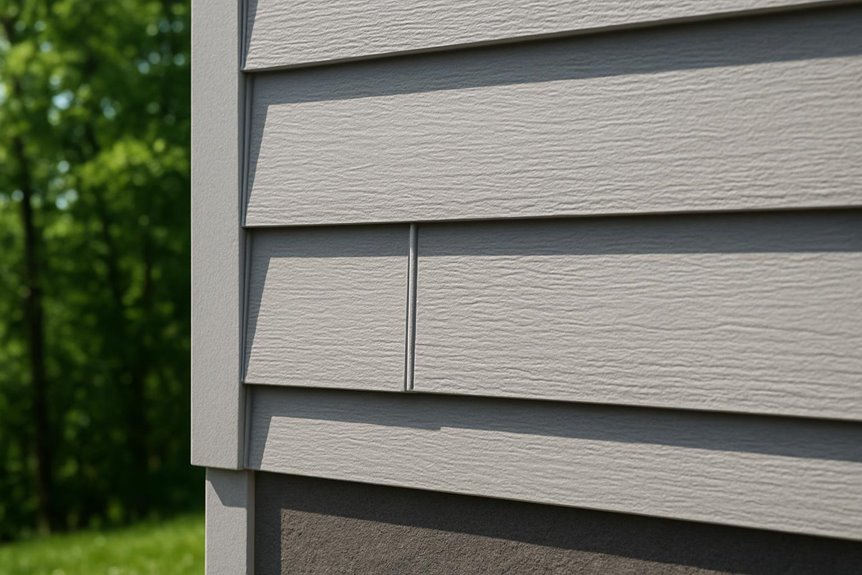
Effective moisture management is paramount in maintaining a building's integrity, as highlighted in the context of water resistance. Fiber cement siding, while highly water-resistant, relies on a thorough wall assembly to prevent water intrusion.
Key components include weather-resistant barriers (WRB), which act as a primary defense by repelling water. Flashing systems direct water away from vulnerable areas like windows and doors, guaranteeing seamless protection.
Weather-resistant barriers and flashing systems provide primary defense, repelling water and safeguarding windows and doors effectively.
Drainage paths are essential for guiding water out of the assembly, preventing accumulation. Ventilation cavities allow airflow, aiding in moisture evaporation and reducing potential damage.
Properly sealed penetrations guarantee that no entry points remain for water ingress. Together, these elements form an effective barrier, preventing water from compromising the structural integrity behind the siding.
Water infiltration behind fiber cement siding can initiate a cascade of structural issues. The primary concern is that trapped moisture may lead to significant problems within the wall assembly.
Despite fiber cement's inherent durability, moisture can exploit any installation defects, leading to:
These issues underscore the importance of meticulous installation and regular maintenance.
Addressing moisture-related challenges promptly can prevent these detrimental outcomes, ensuring the longevity and reliability of the siding system.
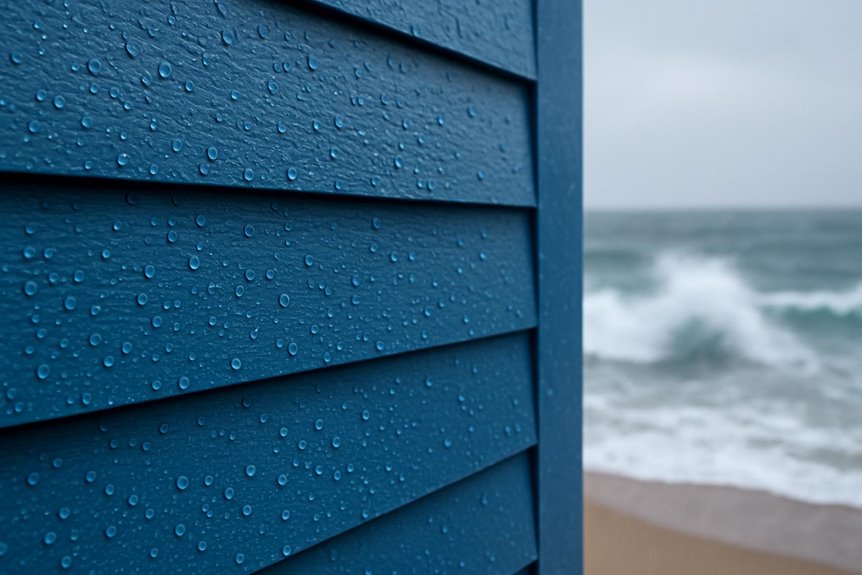
Although fiber cement siding is not entirely waterproof, it excels in wet and coastal environments due to its inherent resistance to rot, insects, and weathering.
Its composition of Portland cement, silica sand, and cellulose fibers provides durability and stability in high-rainfall climates and humid conditions. This material is specifically engineered to withstand freeze-thaw cycles, further enhancing its suitability for challenging environments.
Proper installation and the use of a weather-resistant barrier are crucial to maximize its performance, as minor water absorption can occur at cut edges and seams.
Regular maintenance, such as sealing and repainting, guarantees long-term resilience.
Fiber cement’s robust design and minimal maintenance requirements make it a preferred choice for homeowners in demanding coastal and wet regions.
Why does fiber cement siding excel in wet conditions compared to other materials? Its composition of Portland cement, silica sand, and cellulose fibers provides high moisture resistance, minimizing risks of rot and swelling.
Unlike wood, which swells and decays, fiber cement maintains structural integrity, and unlike vinyl, it remains stable without warping from temperature changes.
The precise engineering of fiber cement siding makes it a preferred choice for those seeking reliable performance in wet conditions.
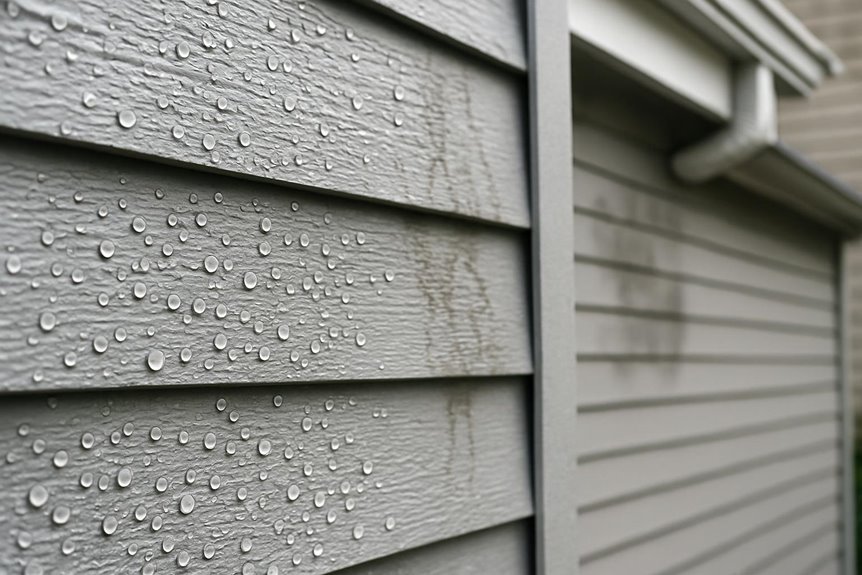
Moisture issues often misinterpreted as fiber cement siding failure are frequently attributed to improper flashing, absence of adequate drainage paths, poor joint detailing, and unsealed penetrations.
These installation oversights can lead to water infiltration, undermining the siding's performance rather than indicating a defect in the material itself.
Addressing these factors during installation guarantees the siding functions effectively, maintaining its protective properties.
A significant factor in water intrusion issues is often improper flashing, which can be mistakenly attributed to siding failure. Flashing is essential in directing water away from vulnerable areas like windows and doors. When improperly installed, it allows moisture to penetrate, leading to damage. This can be misinterpreted as a failure of the fiber cement siding itself, rather than a flaw in installation.
Proper flashing is critical for effective moisture management.
When drainage paths are absent or obstructed, water can become trapped behind the siding, leading to moisture-related issues that may be mistakenly attributed to the failure of fiber cement siding.
This entrapment can cause moisture to accumulate, potentially damaging the underlying structure. Fiber cement siding, while highly resistant to water, relies on a well-designed drainage system to guarantee that any infiltrated moisture is efficiently expelled.
Without these paths, water can seep into seams and joints, exacerbating the problem. Proper planning and installation of drainage channels are essential to avoid such issues.
Utilizing a weather-resistant barrier (WRB) and confirming unobstructed weep holes can notably enhance the siding's performance, preventing common misconceptions about its effectiveness.
Inadequate joint detailing can lead to localized moisture penetration, which may be incorrectly attributed to the failure of fiber cement siding. This issue arises when joints are not properly sealed or aligned during installation.
Fiber cement siding, while highly resistant to water, relies on these joints to maintain its protective barrier. Missteps in joint detailing can compromise the system, leading to moisture infiltration and potential damage to underlying structures.
Key concerns include:
Proper attention to joint detailing is essential for peak performance.
Even with the high water resistance of fiber cement siding, unsealed penetrations present a significant moisture risk. These vulnerabilities occur around fixtures and openings, where improper sealing can create entry points for water.
This can lead to moisture infiltration, mistakenly attributed to siding failure, when the true issue is inadequate sealing. Effective moisture management necessitates meticulous attention to sealing these penetrations during installation.
Employing high-quality sealants and ensuring compatibility with the siding material are essential practices. These measures prevent water ingress and maintain the integrity of the fiber cement siding system.
A systematic approach to identifying and addressing these potential weak points empowers homeowners to effectively mitigate moisture-related issues, preserving the siding’s durability and performance.
How vital is additional waterproofing for fiber cement siding? While the siding itself is highly resistant to water, it does not inherently require waterproof coatings.
However, guaranteeing thorough moisture management involves integrating several components into the wall system. These components are essential for varying climates and designs:
Incorporating these elements provides an additional layer of protection, enhancing the overall durability and longevity of the fiber cement siding.
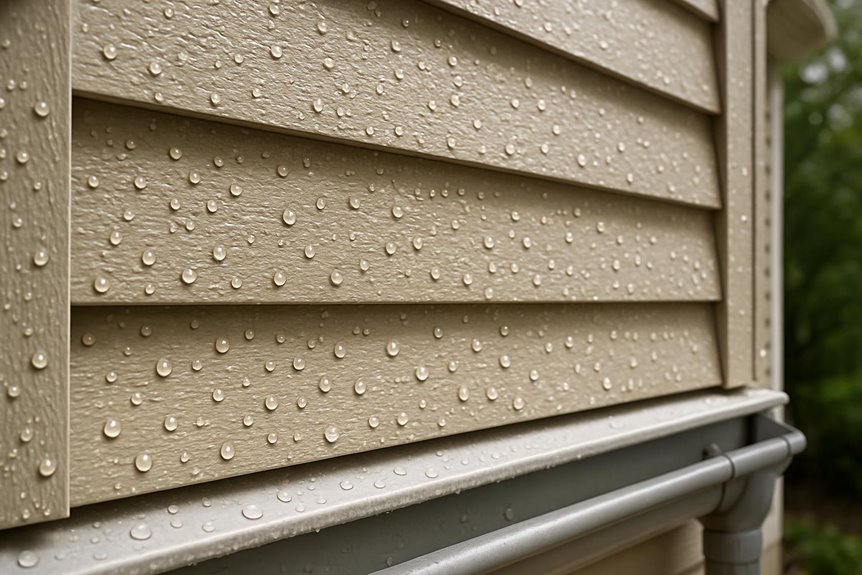
Enhancing moisture resistance in fiber cement siding involves meticulous installation and maintenance practices. Proper installation is paramount; ensuring that all cut edges are sealed prevents water intrusion.
Proper installation, sealing cut edges, is crucial to prevent water intrusion in fiber cement siding.
Flashings around windows, doors, and other connections must be properly installed to avert moisture entry. Regular inspections are vital to identify and address potential issues early, thereby averting costly repairs.
Functional drainage systems are essential, allowing water to escape and reducing moisture retention. Maintaining joints and ensuring they remain sealed further secures the siding's resilience against moisture.
The performance of fiber cement siding in managing moisture is contingent upon the integration of these practices within the entire façade system, offering a robust defense against environmental challenges.
You May Also Like: Is Fiber Cement Siding Fire-Resistant?
Fiber cement siding is suitable for flood-prone areas due to its high water resistance. While not completely waterproof, it effectively withstands moisture when properly installed with a weather-resistant barrier, ensuring durability and minimizing potential damage.
Fiber cement siding should be inspected for moisture damage annually. This guarantees early detection of issues such as cracks, discoloration, or pooling water, allowing for timely maintenance and preventing potential structural or aesthetic problems.
To maintain water resistance, he seals edges like a guardian against nature’s whispers. Proper flashing, repainting with exterior-grade paint, and regular inspections are his arsenal, ensuring fiber cement siding remains a steadfast sentinel against moisture intrusion.
Fiber cement siding requires high-quality, exterior-grade paint for ideal moisture protection. This guarantees durability and extends lifespan by providing a robust barrier against water intrusion, essential for maintaining the siding's structural integrity and aesthetic appeal.
Fiber cement siding performs exceptionally in freezing temperatures, maintaining its robustness without warping or cracking. Its illustrious durability guarantees homes remain impervious to winter's relentless assault, making it a formidable choice for those demanding absolute control over their environment.
Fiber cement siding is water-resistant, not waterproof. While it can withstand rain, humidity, and harsh weather conditions, its performance depends on proper wall design, installation, and moisture management. When specified and installed correctly, fiber cement siding delivers excellent durability, stability, and long-term protection for exterior wall systems.
Looking for reliable fiber cement panel solutions? Contact Philigreen to explore exterior wall systems designed for lasting performance and modern architectural applications.